What the projectile motion equations assume
A projectile is an object moving after launch under gravity. In the simplest model, gravitational acceleration is constant and air resistance is negligible. Choose right as positive x and up as positive y. The horizontal acceleration is then zero, while the vertical acceleration is −g, where g is about 9.81 m/s² near Earth’s surface.
These assumptions matter. Wind and drag can change both velocity components. The familiar range formula also assumes that the projectile lands at its launch height. If the landing surface is higher or lower, calculate flight time from the vertical position equation instead of using the equal-height shortcut.
Resolve launch velocity into horizontal and vertical components
For launch speed v₀ at angle θ above the horizontal, the initial components are vₓ₀ = v₀ cos θ and vᵧ₀ = v₀ sin θ. Without drag, horizontal position changes as x = x₀ + vₓ₀t. Vertical position changes as y = y₀ + vᵧ₀t − ½gt². At any time, vₓ = vₓ₀ and vᵧ = vᵧ₀ − gt.
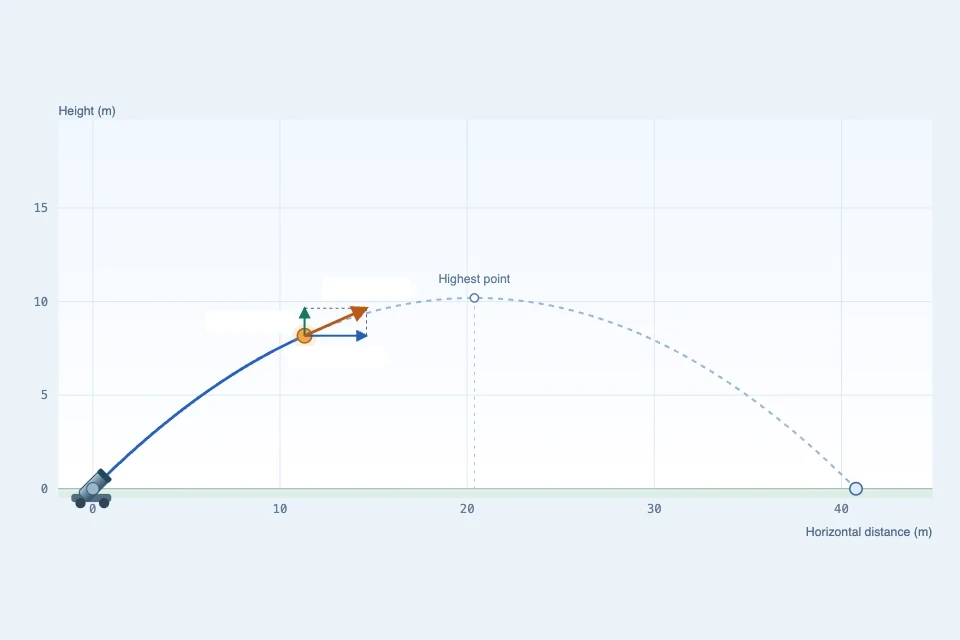
At the highest point, vᵧ is zero for an upward launch, but vₓ is generally not. The object has not stopped; it is still moving horizontally. This is why a velocity arrow at the top of the path points sideways in the ideal model.
Range, maximum height and flight-time formulas
For a launch and landing at the same height, flight time is T = 2v₀ sin θ/g. Maximum height above the launch point is H = v₀² sin² θ/(2g). Horizontal range is R = v₀² sin(2θ)/g. These equations use consistent SI units: speed in m/s, acceleration in m/s², time in s and distance in m.
If the starting height is y₀ above the landing level, solve 0 = y₀ + v₀ sin θ·t − ½gt² for the positive time. Then multiply that time by v₀ cos θ to obtain horizontal distance. The equal-height range formula does not account for the extra time available from an elevated launch.
Worked example: launch at 20 m/s and 30°
Suppose a ball leaves and lands at ground level at 20 m/s and 30°, with no drag. Its initial horizontal speed is 20 cos 30° ≈ 17.32 m/s, and its initial upward speed is 20 sin 30° = 10.00 m/s. Using g = 9.81 m/s² gives T = 20/9.81 ≈ 2.04 s and H = 100/(19.62) ≈ 5.10 m.
The range is R = 400 sin 60°/9.81 ≈ 35.31 m. A quick check is vₓ₀T ≈ 17.32 × 2.04 ≈ 35.3 m. The small difference in the rounded product comes from rounding the intermediate time. Keep extra digits until the final answer.
Why 45° gives the longest ideal range only in one case
With fixed launch speed, equal launch and landing heights, and no drag, sin(2θ) reaches its maximum at θ = 45°. Complementary angles such as 30° and 60° have the same ideal range, but the steeper launch reaches a greater height and stays aloft longer.
The result changes when launch height differs from landing height or when air resistance matters. A headwind, tailwind or drag coefficient must be handled with the fuller motion model. Do not present 45° as a universal best launch angle.
Test the equations in the projectile simulation
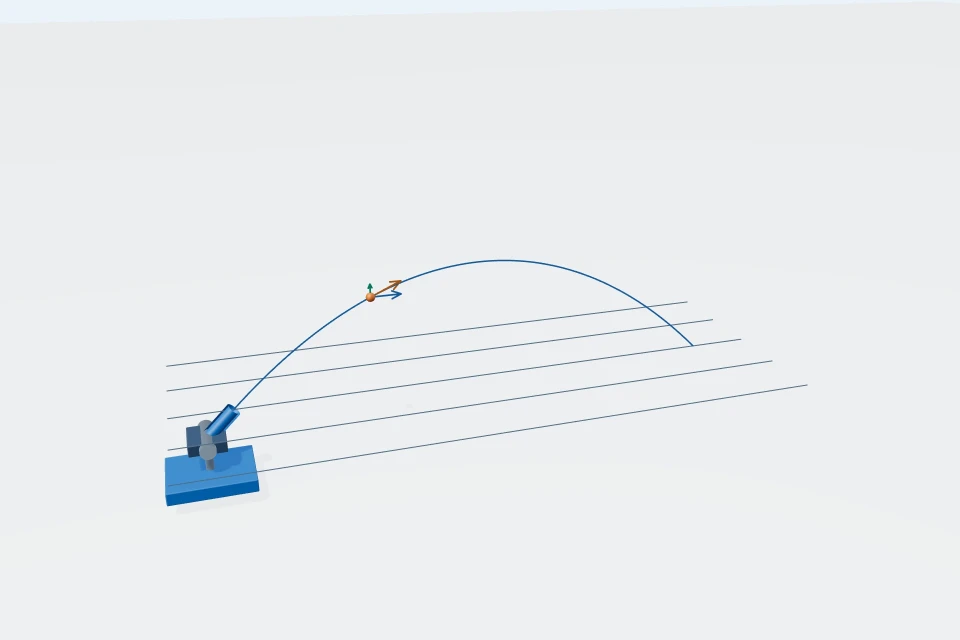
Open the projectile motion simulation, set the starting height to zero, turn air resistance off, and enter 20 m/s at 30°. Predict the three values before revealing results. Inspect the path and the separate horizontal and vertical velocity arrows. The 3D version lets you view the trajectory and apparatus from another angle.
Save the path, change only the angle to 60°, and compare range, height and time. Then raise the starting height or enable drag to see exactly which shortcut stops working. Record the changed assumption next to each observation so the comparison remains meaningful.
Sources and further reading
- OpenStax University Physics: projectile motion and range conditions
- NASA Glenn Research Center: drag equation and its variables
Found an error or a confusing explanation? Send a science correction.